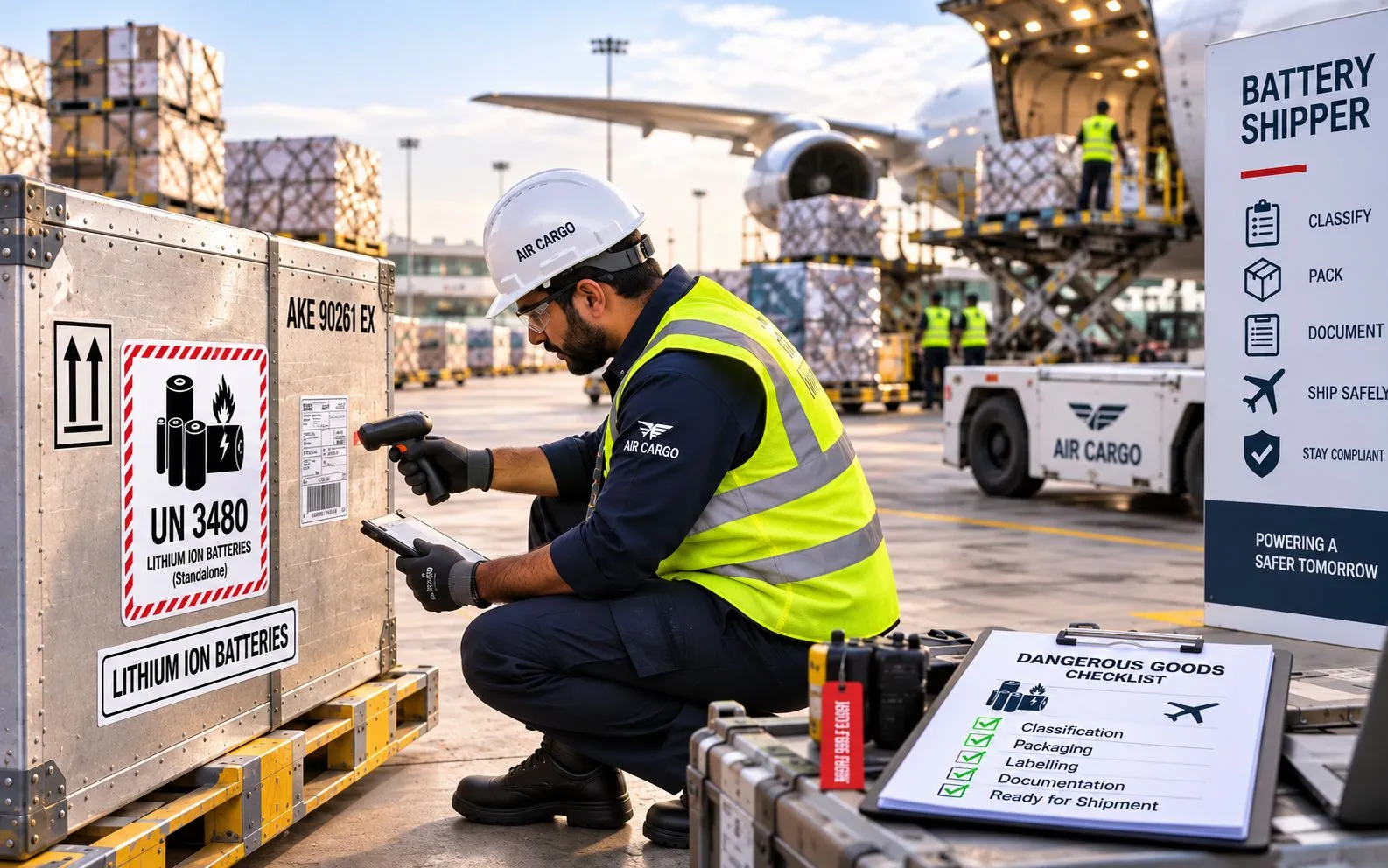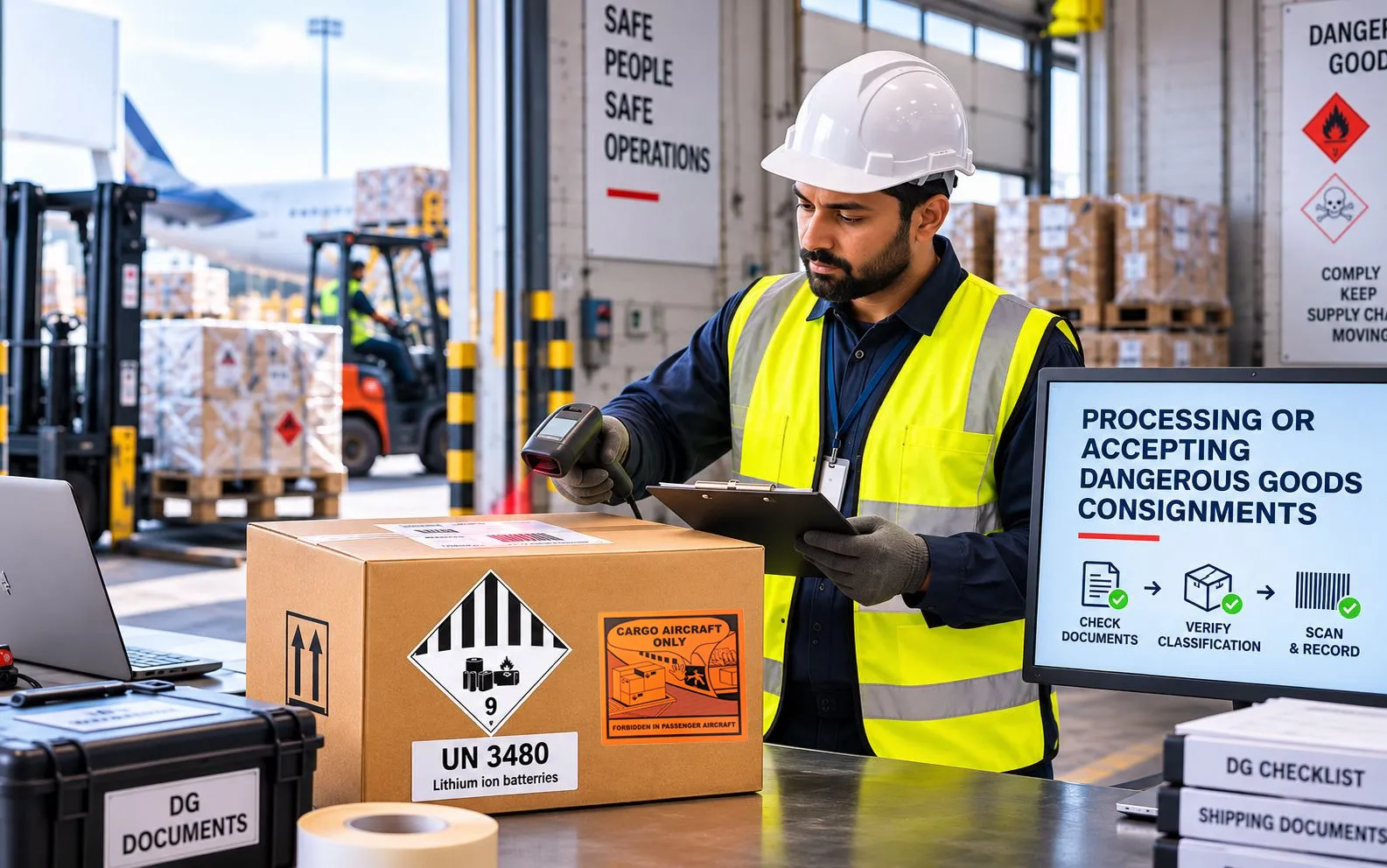
In the UAE, only trained and certified staff may accept dangerous goods consignments for air transport. Under the GCAA’s Civil Aviation Regulations Part VI, staff who process or accept dangerous goods need training for Function 4.1.D, the role previously covered by IATA Category 6. A dangerous goods acceptance course prepares them to check the shipper’s declaration, the air waybill, packaging, marks, labels and approvals before a consignment is accepted.
Acceptance Is the Last Checkpoint Before the Aircraft
Every dangerous goods shipment passes through an acceptance point, where an airline, ground handling agent or freight forwarder formally takes responsibility for it. Up to that moment, the shipper has classified, packed, marked, labelled and documented the goods. At acceptance, a trained member of staff confirms that all of this has been done correctly. If an error slips through here, it can travel all the way to the aircraft hold, which is why acceptance is one of the most closely regulated roles in air cargo.
The work demands both knowledge and judgement. Acceptance staff compare documents against packages, check quantities against limits, look for the right marks and labels, and confirm that any approvals or variations have been met. They also need the confidence to refuse a consignment and explain why.
The Roles That Need Acceptance Training
The GCAA defines Function 4.1.D as personnel responsible for processing or accepting dangerous goods consignments, or accepting mail containing dangerous goods. In practice, that includes airline cargo acceptance staff at cargo terminals, ground handling agents accepting dangerous goods on behalf of airlines, and freight forwarder staff who receive dangerous goods from shippers. It also covers people performing the Dangerous Goods Post Holder function for air operators, including operators that do not carry dangerous goods, and staff at designated postal operators who accept mail. For all of these roles, a dangerous goods acceptance course is the qualification the regulator expects.
From IATA Category 6 to GCAA Function 4.1.D
Many people still search for DGR Cat 6 training, because acceptance staff used to complete what IATA called Category 6. Under competency-based training and assessment, IATA replaced numbered categories with functions, and the GCAA’s CAR Part VI uses its own Function in Table codes. The role once covered by the IATA DGR Category 6 course now sits under GCAA Function 4.1.D and IATA function 7.3.A. The job is the same, while the training framework now focuses on demonstrated competence.
| Framework | Code for acceptance training |
|---|---|
| Former IATA categories | Category 6 |
| IATA competency-based training | Function 7.3.A |
| GCAA CAR Part VI | Function 4.1.D |
What Acceptance Staff Learn
A dangerous goods acceptance course starts with the fundamentals: recognising dangerous goods and understanding how the IATA Dangerous Goods Regulations apply. From there, trainees learn how shippers classify, pack, mark and label goods, so they know what a correctly prepared consignment should look like. The core of the course is verification. Trainees practise checking the shipper’s declaration and the air waybill, inspecting packages for the right marks, labels and quantities, and confirming that state and operator variations, approvals and exemptions have been met. They learn to use an acceptance checklist consistently, so that every consignment is checked the same way. DGR Aviation’s initial acceptance course runs over four to five days, reflecting the depth of knowledge the role demands.
The Cost of an Acceptance Error
When an error is missed at acceptance, the consequences can range from rejected shipments and delays to regulatory penalties and, in the worst cases, incidents in flight. Accurate acceptance protects the aircraft and crew, and it also protects the business. Problems caught at the counter can be corrected before they cause wider disruption, while problems found later are harder and more expensive to resolve.
Confidence at the Counter
Acceptance staff often work under pressure, with trucks waiting and flights to meet. Good training gives them the confidence to stop a non-compliant consignment, explain the problem to the shipper or forwarder, and record the reason. Organisations that back their acceptance staff in these decisions build a stronger safety culture and see fewer problems further down the chain. Many also appoint a Dangerous Goods Post Holder or senior specialist to support frontline staff with difficult cases and keep procedures up to date.
Keeping Certification Current
Dangerous goods regulations are updated every year, and training must be refreshed regularly. Under the IATA Dangerous Goods Regulations, recurrent training must be completed within 24 months of previous training. Employers should keep training records up to date and plan recurrent courses before certificates expire, so acceptance staff can continue working without interruption.
Choosing the Right Training Provider
Acceptance training is most effective when it is delivered by a provider approved by the GCAA and accredited by IATA, with instructors who have worked in cargo acceptance. Practical exercises using real documents and packages help trainees apply the rules to the situations they will meet on the job.
DGR Aviation Training Services LLC is a GCAA Approved Training Organisation and IATA Accredited training provider in Dubai, delivering GCAA competency-based dangerous goods training across functions 4.1.A to 4.1.M, from shippers and acceptance staff to warehouse teams and flight operations personnel. Our GCAA 4.1.D dangerous goods acceptance course prepares acceptance staff to check and accept dangerous goods with confidence.
Frequently Asked Questions
What is a dangerous goods acceptance course?
Training for staff who process or accept dangerous goods consignments, covering checks of documents, packages, marks, labels and approvals before acceptance.
Is DGR Cat 6 training still available?
The former IATA Category 6 role now aligns with GCAA Function 4.1.D and IATA function 7.3.A, and acceptance training continues under these codes.
Who needs GCAA 4.1.D training?
Airline cargo acceptance staff, ground handling agents, freight forwarder acceptance staff, Dangerous Goods Post Holders and designated postal operators.
How long is an IATA DGR Category 6 course?
Initial acceptance training at DGR Aviation runs over four to five days.
How often must acceptance training be repeated?
Recurrent training must be completed within 24 months under the IATA Dangerous Goods Regulations.